
You Don’t Have to Get Every Business Decision Right — You Just Need to Learn From the Ones You’ve Made
You’ve run the numbers.
You’ve talked it through with your spouse, your business partner, your accountant, another business owner — maybe all of them. You’ve made the pros-and-cons list. You’ve changed your mind three times.
And you still don’t know. Because, the truth is, you’re not just trying to make the right decision.
You’re trying to avoid the feeling of making the wrong one.
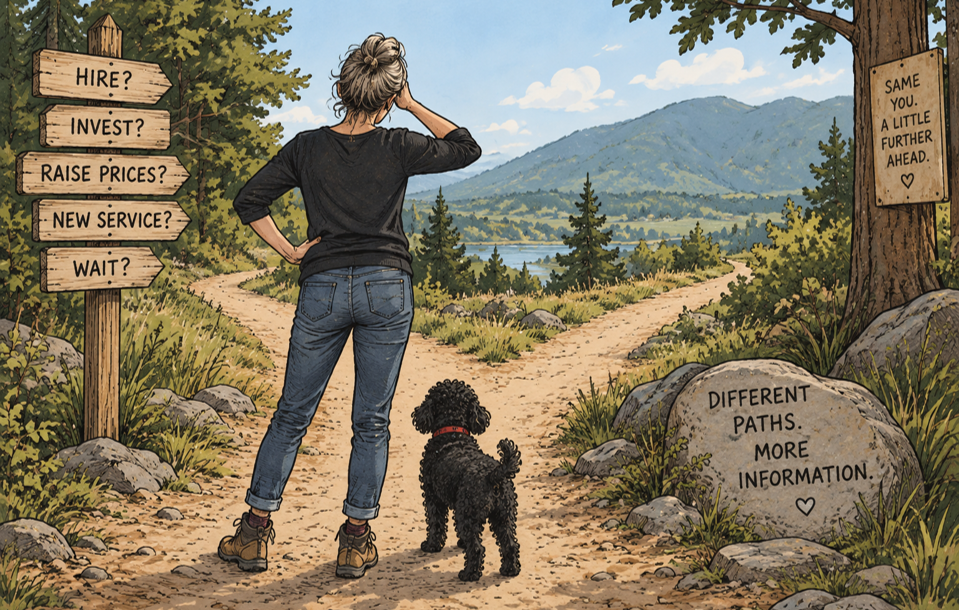
Do I hire the person?
Spend the money on marketing?
Buy the equipment?
Raise my prices?
Add the new service?
You go back and forth because the stakes feel personal. It’s your money. Your business. Your livelihood. If you get it wrong, you’re the one who pays for it.
So maybe you wait.
Do a little more research.
Ask one more person.
Run the numbers again — not because you expect a different answer, but because you want to feel a little less exposed.
Or you finally make the decision…and then spend the next three months wondering whether you jumped too soon, waited too long, or missed something obvious.
But what if getting the decision right isn’t actually the job?
What if the job is making the best decision you can with what you know — and having a way to see what happens next?
Then the business gets a vote
Say you finally hire someone because you’re drowning.
The plan is simple: another person should create breathing room.
Three months later, you’re still drowning — just in different water.
You’re paying another salary, training someone, and somehow still working until 8:00 every night.
That’s information.
Or you spend $10,000 on marketing because you need more business.
The leads come in — but they’re the wrong kind.
Or they’re fine, but they don’t convert.
Or they convert, but they’re low-margin and exhausting.
That’s information too.
Or you finally raise your prices after agonizing over how many customers you’re going to lose.
Almost nobody leaves.
But you still feel guilty every time you send an invoice.
Well, shit.
That’s information.
Every decision starts with some version of:
If I do this, I think this will happen.
Then reality shows up with its own opinion.
And the difference between what you thought would happen and what actually happened is where some of the most useful information in your business lives.
Your business is a system
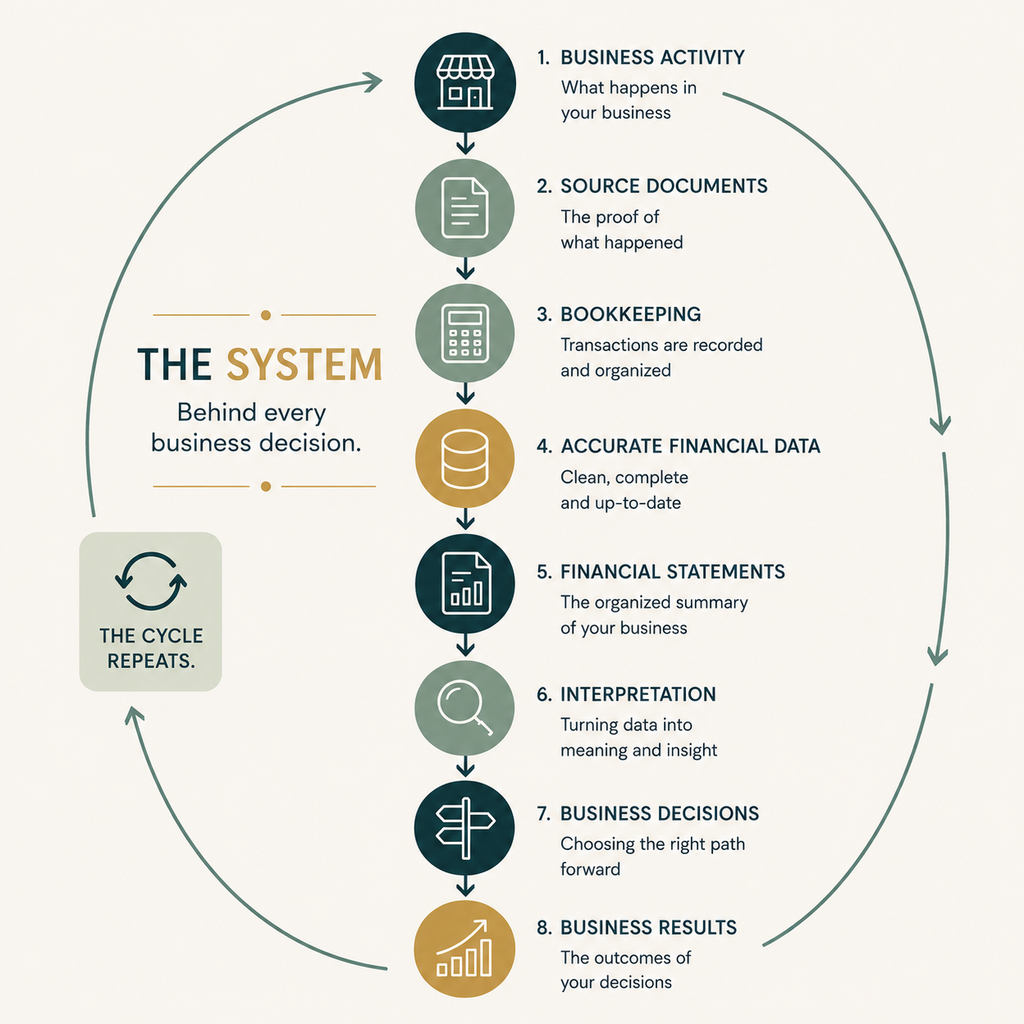
Every decision creates activity. And that activity creates information.
Some of it you’ll feel immediately.
We’re busier, but I’m still working just as much.
The phone is ringing, but these aren’t the jobs we want.
Revenue is up. Why the hell is there less cash?
Some of it shows up in the numbers.
That’s why I think of this less as a circle and more like a spiral.
You make a business decision. Something happens. You notice. You evaluate. You adjust.
And when you come around again, you’re not quite where you started.
You know something you didn’t know before.
Okay, but how long do I give it?
You hire someone and the first month is worse because you’re training them.
You invest in marketing and nothing happens for six weeks.
You add a service and the first few clients are clunky because you’re still figuring out how to deliver it.
Now what?
Is it not working?
Or has it just not worked yet?
That question gets a lot harder to answer if you never decided what “working” was supposed to look like.
Before you spend the money, make the hire, or change direction, ask:
What am I expecting this decision to change?
And then:
What would I expect to see if it’s working?
It doesn’t need to be a 14-tab spreadsheet.
Maybe the new hire is supposed to free up ten hours of your week.
Maybe the marketing investment needs to produce a certain number of qualified opportunities.
Maybe the equipment should let you complete more jobs without adding labor.
Maybe the price increase needs to improve margin without costing you more customers than you’re willing to lose.
Now you have something to watch.
And deciding that before you know the outcome matters.
Because once we’ve made a business decision, it’s awfully easy to start moving the goalposts.
It just needs more time.
She’s still learning.
We just need more volume.
Sometimes that’s absolutely true.
And sometimes we’re defending the decision because admitting it isn’t working feels suspiciously like admitting we were wrong.
But those aren’t the same thing.
Changing course doesn’t make the first decision wrong
You can change your mind.
You can tweak the plan.
You can give something more time.
You can stop doing something that isn’t working.
You can discover that your original assumption was completely wrong.
That doesn’t automatically mean you made a bad decision.
You made a business decision with the information you had.
Now you have more information.
The question is what you do with it.
That’s why good financial information matters — not because you need another report sitting in your inbox, but because it can shorten the distance between:
“I think this will work.”
and
“Here’s what actually happened.”
You don’t need to predict the future
There are decisions worth analyzing carefully before you make them.
But eventually, analysis runs out.
Business doesn’t come with an answer key.
You won’t always know whether a decision is right before you make it.
But you can know what you’re trying to change.
You can decide what you’ll watch.
And you can have a system that lets you see what actually happened.
Decide. Notice. Evaluate. Adjust.
Then go around again.
Only this time, you know more.