
Financial statements aren’t just the end product of accounting. They’re an input into the next business decision—at every turn.
Most businesses produce financial statements.
Maybe your bookkeeper sends them every month. Maybe you pull them out of QuickBooks when you need them. Maybe you don’t see them until your CPA asks for them at tax time.
Either way, the reports exist.
But here’s the real question:
What do you actually do with them?
Because if you’re not going to use the information, you might as well stack the reports in a closet and shut the damn door.
Financial statements aren’t the finish line of accounting.
They’re the starting point for the next decision.
And that distinction matters.
Your business doesn’t stop when the month ends
Accounting works in periods.
January. Q1. Year-to-date. Year-end.
We need those periods to measure and report financial activity. But your business doesn’t operate in tidy blocks of time.
It didn’t stop at 11:59 p.m. on July 31 because the accounting system needed to close the month. August 1 arrived. Customers still needed something. Employees showed up. Bills landed. Decisions had to be made.
The business kept moving.
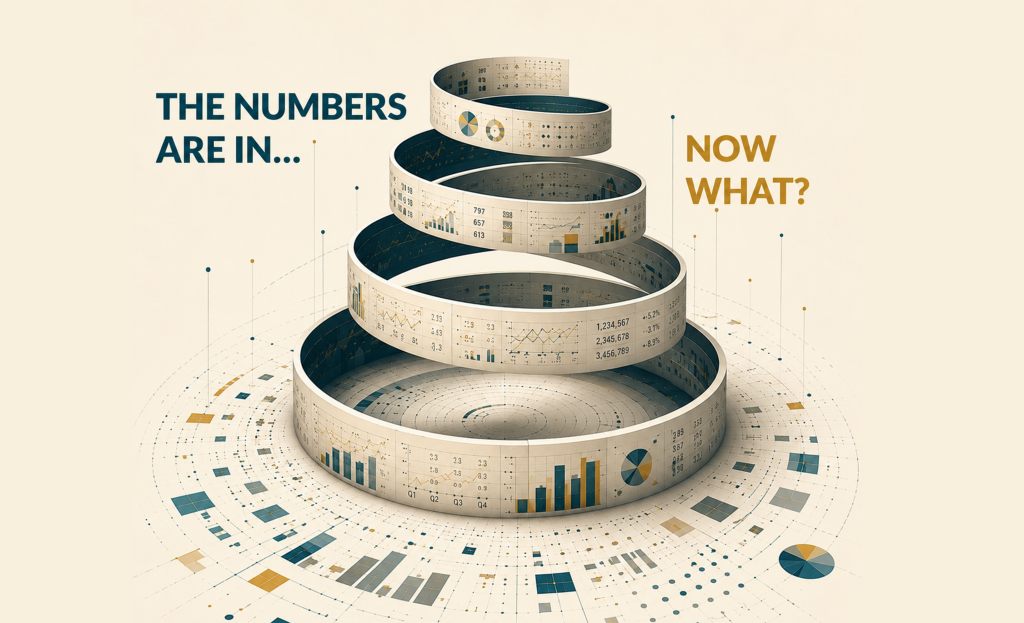
That’s why financial statements aren’t the end of a process. They’re part of a larger system:
Business activity → Transactions → Accounting → Financial statements → Context + Questions → Understanding → Decisions + Action → New business activity
But that’s not a circle.
It’s a spiral
A circle implies you eventually return to where you started.
A business doesn’t.
Each turn through the system adds something new.
Maybe you hired someone. Raised prices. Added a service. Lost a major customer. Took on debt. Entered a new market. Hit a capacity constraint. Shifted strategy.
Or maybe nothing dramatic happened at all—but you still gained another month, quarter or year of evidence about how the business behaves.
You’re not starting each turn with the same information you had before. You’re carrying the previous turns with you.
Patterns become visible. Trends emerge. Assumptions can be tested. Decisions you made months ago begin producing results of their own.
The cycle repeats. The business doesn’t.
That’s why it’s not a circle.
It’s a spiral.
Reporting isn’t the same thing as feedback
A business can have pristine monthly financial statements and still have no meaningful financial feedback loop.
The reports can arrive on the 10th of every month. The accounts can be reconciled. The P&L and Balance Sheet can be accurate.
And the owner can save them to a folder and never look at them again.
That’s reporting.
It isn’t feedback.
Information becomes feedback only when you use it to understand what’s happening and inform what happens next.
And that requires context.
Suppose July’s gross margin declined.
Okay.
Compared with what? June? Last quarter? July last year? The same period over the last three years? Is there seasonality? Did product mix shift? Did labor costs move? Did a supplier raise prices? Did something change in the market? Was the decline expected because of a decision you made intentionally?
The number shows you what happened.
It doesn’t, by itself, explain what it means.
That’s where context matters.
Financial statements give you evidence. Your knowledge of the business gives that evidence context.
Together, they let you ask better questions.
I learned the context lesson a long time ago
Years ago, I worked in a Controller/CFO role for a company that manufactured high-performance technical skiwear and athletic apparel.
Sarah (not her real name) handled accounts payable. Another team member handled accounts receivable. I was building and refining systems, which meant sometimes asking them to process something in a particular way.
And I remember thinking:
If I were sitting in their chair, I’d be wondering why the hell she’s asking me to do it this way.
From their vantage point, the request didn’t always make sense.
So I told them.
I explained where the information was going, how it affected something downstream, and why I needed the data captured a certain way.
I gave them the context.
With Sarah especially, I didn’t just teach her the task in front of her. I shared what I was doing, how I was thinking, and how the pieces fit together.
Eventually, I was laid off and someone else was hired into my role.
He didn’t last.
And guess who stepped into the role seamlessly?
Sarah.
Not because processing accounts payable magically taught her how to be a Controller.
But because she’d learned to see beyond the task.
She understood the system.
Business owners need the same thing
Financial statements without context aren’t all that different from handing someone a task without explaining why it matters.
Yes, the numbers matter. Yes, they need to be accurate.
I’ve said it before: No good decision comes from bad data.
But accuracy is the prerequisite—not the destination.
The goal isn’t pristine financial statements for the sake of being “done.”
The goal is reliable information that helps you see what’s happening and ask better questions.
Why is margin moving? What’s driving cash? Which part of the business is actually creating profit? Is this a one-month anomaly or the beginning of a trend? Is this normal seasonality or a fundamental shift? What happened after we raised prices? Did that new hire actually increase capacity? Is the investment producing what we expected? Is the business moving toward what we’re trying to build—or away from it?
Financial statements don’t answer all of those questions.
And they certainly don’t make the decisions for you.
They show you evidence.
You interpret that evidence using the history of the business, the patterns you’ve observed, what’s happening operationally, what’s changing externally, and where you’re trying to go.
Then you decide.
And that decision becomes part of the next turn.
Accurate data → Reliable financial statements → Better questions → Deeper understanding → Intentional action → New information
And the spiral continues.
So what are your financial statements showing you?
Compliance is one reason we produce them—tax returns, lenders, reporting requirements, documentation.
Those things matter.
But compliance is only one part of what accounting does for a business.
If compliance is the only reason, you’re leaving a tremendous amount of value on the table.
Your business is already producing the information. Every transaction, every month, every quarter, every year adds another layer of evidence.
Look across time and patterns emerge. Add operational and external context and you begin to understand why those patterns occur. Ask better questions and you can decide whether something needs to change.
Then you act.
And eventually, the results of that action show up in the numbers too.
That’s the feedback loop.
But as you carry what you learn from one loop into the next, you don’t return to where you started.
The loop begins to spiral.
Each turn gives you more context, more evidence, and another opportunity to make a more intentional decision about what happens next.
Financial statements aren’t just a record of where your business has been.
Used well, they help you see where you are, understand how you got there, and make more intentional decisions about where you go next.
Financial statements aren’t the end product of accounting. They’re an input into the next business decision—at every turn.
The cycle repeats.
The business doesn’t.
And that’s the point.