
Why professional titles matter far less than the work actually being done.
In my previous article, “I Have an Accountant…Which Kind?”, we explored the three disciplines of accounting:
- Financial Accounting – What happened?
- Tax Accounting – How is it taxed?
- Managerial Accounting – What does it mean, and what should we do next?
Those disciplines explain the work.
But they don’t answer this critical question:
“Who actually does all of that work?”
That’s where business owners often get confused.
People introduce themselves as bookkeepers, accountants, controllers, CPAs, advisors, or CFOs. But those titles don’t actually tell you what they’re responsible for—or what they’re doing for your business.
The title matters far less than whether the right work is getting done.
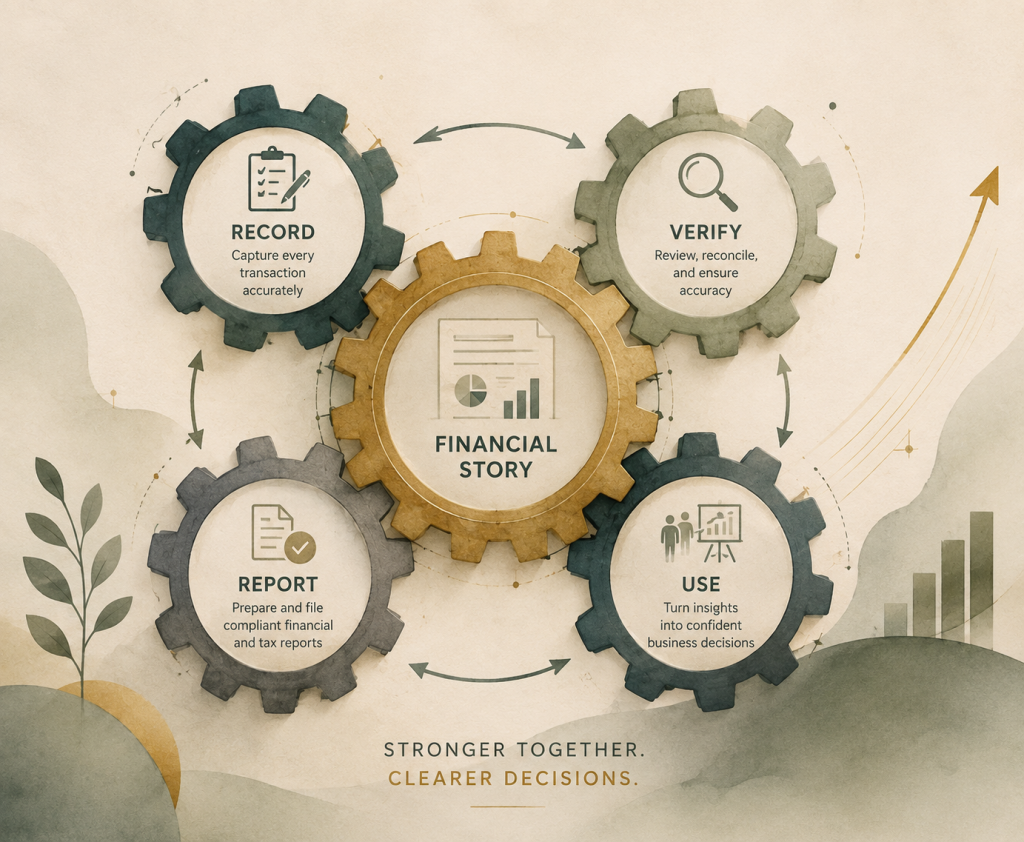
Every Healthy Business Needs Four Financial Functions
Here’s the way I think about it.
A healthy business doesn’t necessarily need four different financial professionals.
It does need four essential financial functions covered.
Depending on the size and complexity of your business, one person may perform several of these functions. In a larger organization, each may be handled by different specialists.
The question isn’t:
“Who do I have?”
The better question is:
“Which financial functions are actually being performed—and are they being performed well?”
1. Record the Story
Everything starts here.
Bookkeeping is about much more than recording transactions. In “Bookkeeping Is More Than Just a Few Clicks,” I explain why the real work of bookkeeping happens long before someone clicks “Run Report.”
That includes:
- Recording transactions accurately
- Reconciling bank and credit card accounts
- Organizing financial information consistently
- Maintaining a Chart of Accounts that reflects how your business actually operates
When this work is done well, your financial statements tell the story of what happened.
When it isn’t, every report that follows becomes less reliable.
I’ve said it before, and I’ll keep saying it:
No good decisions come from bad data.
2. Verify the Story
This is the function many small businesses don’t realize they’re missing.
Someone needs to step back and ask:
“Do these numbers actually make sense?”
This is controller-type work.
It includes reviewing reconciliations, identifying unusual activity, verifying balances, checking for inconsistencies, and making sure everything ties together logically.
Controllers don’t create the numbers.
They make sure you can trust them.
There’s an important distinction.
Financial statements aren’t trustworthy simply because someone produced them.
They’re trustworthy because the underlying bookkeeping is accurate.
3. Report the Story
Once reliable financial information exists, it can be used to meet reporting requirements.
This is where the work of your accounting team and your tax professional come together.
Throughout the year, your bookkeeper or accountant may be responsible for preparing operational reports and filings such as payroll tax returns, sales tax filings, and other routine compliance requirements.
Your CPA then uses the financial records—and often those completed filings—as part of preparing your business tax return and ensuring it’s reported correctly under the tax code.
Each role builds on the work that came before it.
That’s why reliable financial records matter so much.
A tax return can only reflect the information it’s given.
4. Use the Story
This is where the numbers become useful.
An advisor or CFO helps connect financial information to business decisions.
Questions like:
- Which jobs or projects are actually making us money?
- Are we pricing our work appropriately?
- Can we afford to hire another employee?
- Why is cash tighter even though we’re profitable?
- Which customers are our most profitable?
- Where are our margins starting to slip?
- What happens if we add another truck, location, or product line?
Financial statements tell you what happened.
Good advisory work helps you understand why it happened, what it means, and what to do next.
This is where accounting becomes a management tool instead of simply a reporting requirement.
When the Lines Start to Blur
Here’s where things get interesting.
The lines between these roles have become much less defined over the last decade.
Today it’s common to see:
- Bookkeepers offering advisory services.
- CPAs providing bookkeeping.
- Fractional CFOs redesigning financial reports.
- Business coaches giving tax advice.
- Software promising to replace all of them.
None of those things are automatically wrong.
In fact, many experienced professionals successfully wear multiple hats.
The question isn’t how many hats someone wears.
The question is whether they truly understand the function they’re stepping into.
A CPA Offering Bookkeeping
Many CPA firms now offer bookkeeping services.
There’s absolutely nothing wrong with that.
But tax accounting and financial accounting are different disciplines with different objectives.
A CPA’s primary expertise is interpreting and applying the tax code. That certainly includes preparing an accurate business tax return, but it often goes much further than that.
A good CPA may recommend strategies to legally reduce your tax liability, such as establishing a SEP IRA or company-sponsored retirement plan, evaluating depreciation elections, or considering an S Corporation election when appropriate.
The key words there are “when appropriate.”
The S Corporation election has become one of the most over-simplified pieces of business advice on the internet, and it deserves a much more thoughtful conversation than it usually gets. I’ll tackle that topic in a future article.
These conversations can be incredibly valuable.
But they rely on something that comes first.
Reliable financial records.
Financial accounting, on the other hand, is about creating accurate financial information that helps you understand and manage your business throughout the year.
If bookkeeping errors go unnoticed—miscategorized transactions, unreconciled accounts, or a poorly designed Chart of Accounts—the tax return may still be completed.
The tax planning may still happen.
But the financial statements you rely on to run your business may no longer tell an accurate story.
That’s not a criticism of CPAs.
It’s simply recognizing that every discipline has its own expertise.
An Advisor Restructuring the Books
I see this one more often than people realize.
An advisor or CFO may recommend changing the structure of your financial statements to make reporting “cleaner” or easier to understand.
Sometimes those recommendations are exactly what’s needed.
Other times, changes are made without understanding the accounting principles behind the financial statements.
Collapsing accounts, combining categories, or restructuring the Chart of Accounts may make reports look simpler…
…while quietly reducing the integrity of the underlying financial information.
The goal isn’t prettier reports.
The goal is better information.
Owners need insight.
But they shouldn’t have to sacrifice the integrity of their financial records to get it.
A Bookkeeper Offering Advisory
The same principle applies in the other direction.
Many experienced bookkeepers provide excellent business insight because they’ve spent years understanding how businesses operate.
Others may be exceptional at recording transactions but have little experience interpreting financial performance or helping owners make strategic decisions.
Recording the story and interpreting the story are different skill sets.
Sometimes they’re found in the same person.
Sometimes they aren’t.
It’s Not About Staying in Your Lane
This isn’t an argument that everyone should stay in a narrowly defined role.
Some of the best professionals I’ve worked with have expertise that spans multiple disciplines.
Cross-functional knowledge is incredibly valuable.
What becomes dangerous is assuming expertise simply because the titles sound related.
Bookkeeping.
Financial accounting.
Tax.
Advisory.
They’re connected.
But they’re not interchangeable.
Understanding where one function ends and another begins helps protect the integrity of your financial information—and ultimately leads to better business decisions.
The Owner Has a Role Too
Even with an outstanding financial team, there’s one function no one else can perform.
Yours.
Your team can produce reports.
They can explain trends.
They can identify risks.
They can recommend options.
But only you understand your customers, your goals, your vision, and the realities of running your business every day.
Your financials don’t replace your judgment.
They support it.
The best decisions happen when accurate financial information meets the owner’s knowledge of the business.
That’s where clarity comes from.
And that’s ultimately what every accounting function should be working toward.
Owner Takeaway
If you remember nothing else from this article, remember this:
You don’t need every title.
You don’t necessarily need a bookkeeper, an accountant, a controller, a CPA, and a CFO.
But you do need every financial function covered.
Someone needs to record the story.
Someone needs to verify the story.
Someone needs to report the story.
Someone needs to help you use the story.
And as the owner…
You need to understand the story.
Because no one will ever know your business better than you.
The title on someone’s business card matters far less than the function they’re performing for yours.
Because good decisions begin with good information.